- >>
- Birds Online – English
- >>
- Health and diseases
- >>
- General health topics
- >>
- Signs of illness
- >>
- What droppings tell you
What the droppings can tell you
Bird droppings are more than a pile of dirt. The excrements can provide a lot of useful information about the animal’s health condition. Color, consistency, and last but not least the distribution of the droppings on the floor can indicate to the attentive bird owner whether the animal is possibly suffering from a disease or an infestation with parasites.
Please keep in mind: The details explained in this article refer predominantly to the droppings of budgies. For other bird species, it may be different. For example, some species mainly feed on fresh food. The regular consistency of their droppings is therefore completely different than what you would expect from seed-eating birds like budgies.
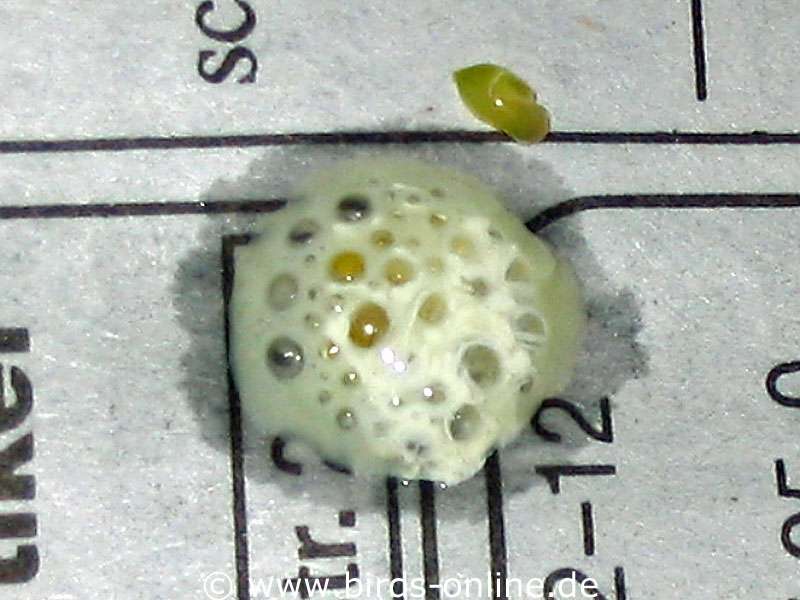
Before some frequently occurring changes of the droppings are described, it is first explained what these droppings actually are. Birds have only one posterior body orifice, the so-called cloaca. That’s where feces and urine leave the body. In many bird species, this happens as a combined pile. So bird droppings are not the same as feces since they also contain urine. Because budgies predominantly eat dry food (seeds), their fecal component is usually fairly solid, unless the animal has just consumed a lot of liquid (water or fresh food like vegetables) or is sick. Also, the urine portion of the budgie’s droppings is relatively firm in general. It’s completely different regarding the droppings of a Lineolated parakeet. These birds eat a lot of fresh food (mainly fruit and vegetable). Their feces portion is relatively solid to slightly mushy and the urine portion is usually liquid to creamy.

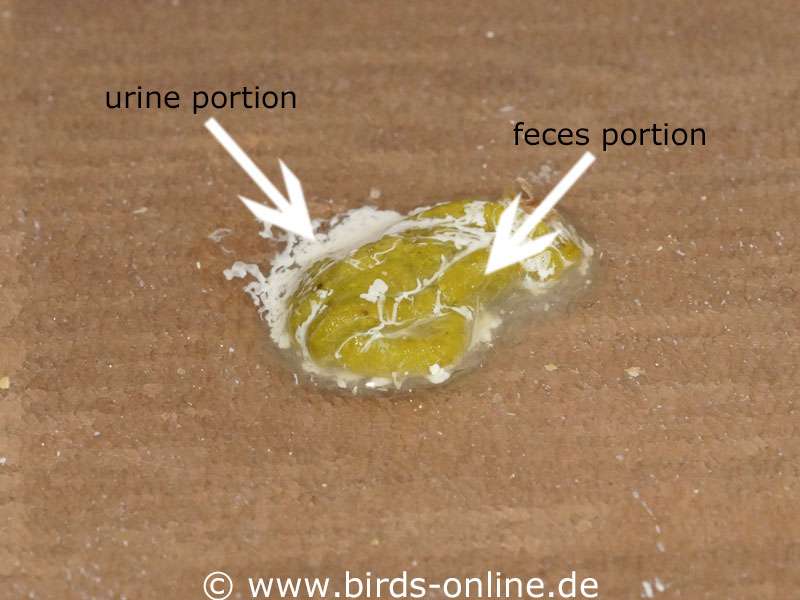
Important note: What is typical for one bird species may be a deviation from the standards for another. If the droppings of a budgie would look like those of a Lineolated parakeet, this would be far from normal. The droppings would be too wet and an underlying disease could be the reason for it.
Consistency of the droppings
A typical dropping of a budgie consists of a dark, solid area (the fecal component) with a white to whitish urine portion in the middle. The urine is creamy to relatively solid unless the bird has drunk a lot or eaten fresh food like vegetables and fruits shortly before. If the texture of the bird poop deviates from the previously described consistency for more than about two hours, this could be an indication of a (beginning) health disorder.

Very liquid droppings that contain more humidity than solid parts and occur over a longer period can indicate a kidney problem like inflammations (nephritis). If, on the other hand, the fecal component itself is fluid, the bird is likely to suffer from diarrhea. In both cases, the bird owner should be on alert. Please contact your avian vet as soon as possible, because sometimes dangerous infections cause these symptoms. It makes sense to have a feces sample examined by a laboratory or the vet for bacteria or fungi to find out which pathogen is causing the digestive problems in the respective case.

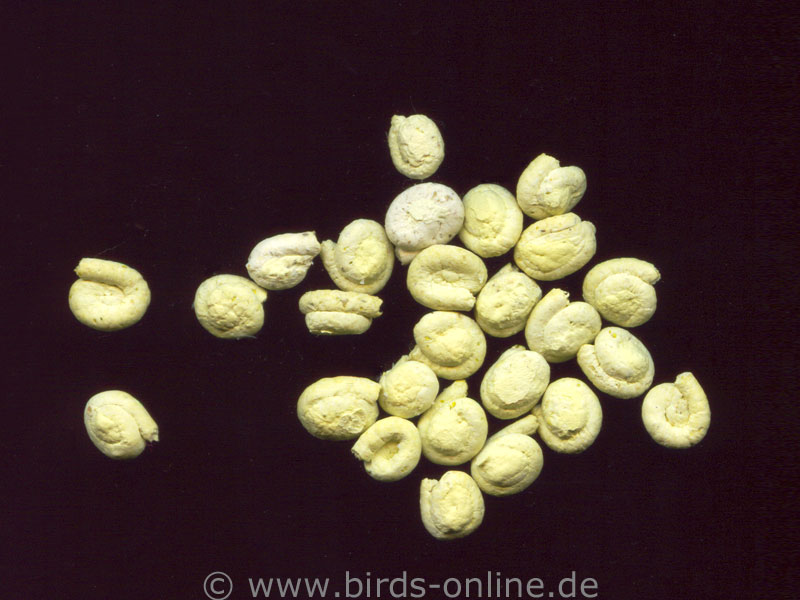
If all droppings of your budgie appear voluminous, crumbly and their color has changed to light gray or light gray-brown, this indicates an infection or malfunction of the pancreas. Some bacterial infections of the digestive tract may also temporarily cause the same kind of chance regarding the dropping’s inconsistency. Therefore it is very important to take your bird to an avian vet quickly. Both, an infection of the digestive system and a malfunction of the pancreas should be treated quickly to save the bird’s life.
Changes in the color of the fecal component or the droppings
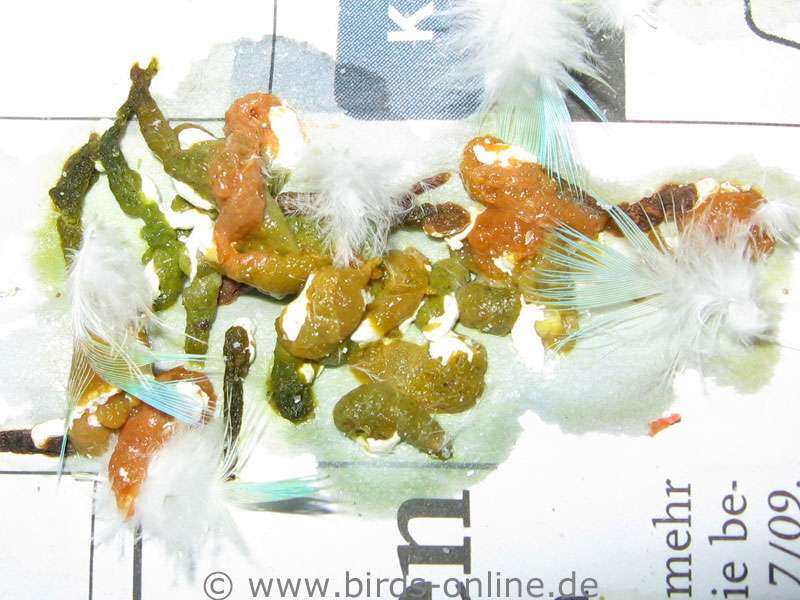
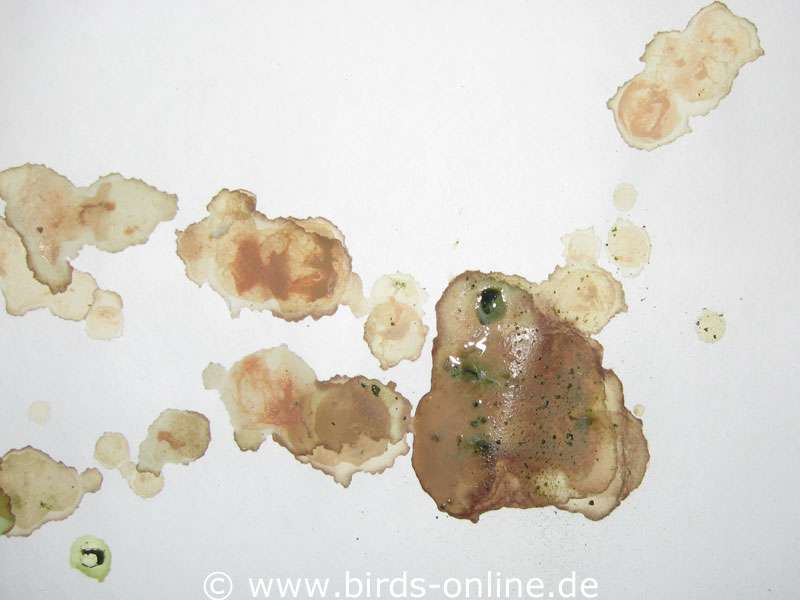
In case you find reddish or dark brown to deep black droppings, blood could be responsible for the discoloration unless you have previously served fresh food like a beet. Also, cherries as well as some berries temporarily lead to reddish droppings. However, if the droppings or the fecal components remain discolored for a longer time (more than two hours), you should have them examined by an avian vet or laboratory for traces of blood. Your veterinarian should also find out quickly if there is any bleeding in the bird’s intestines or kidneys.
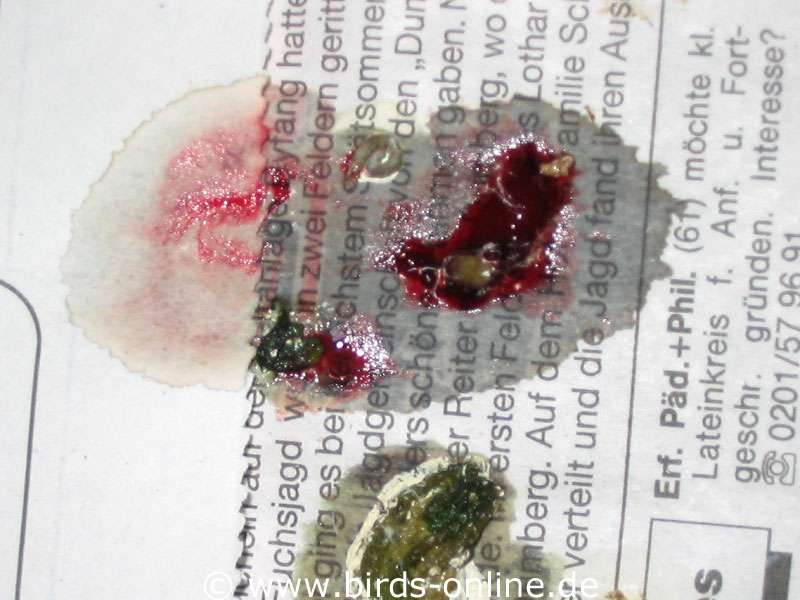
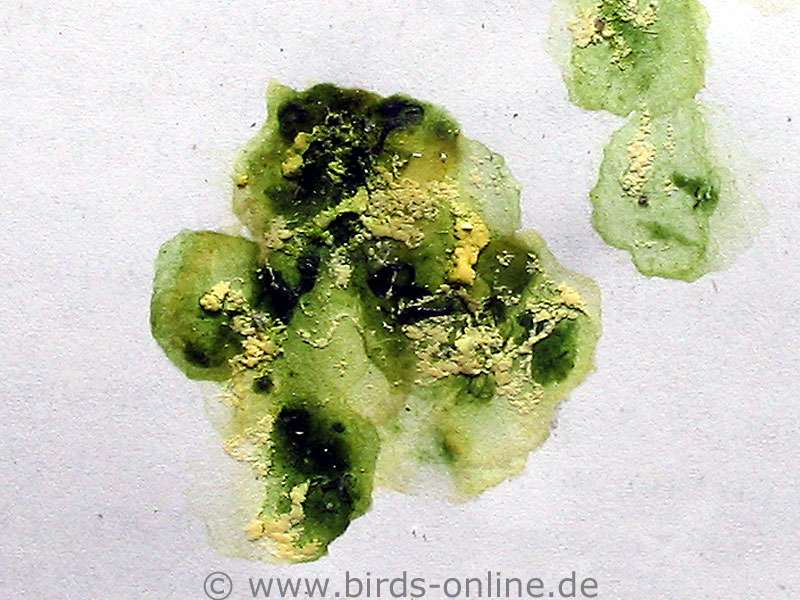
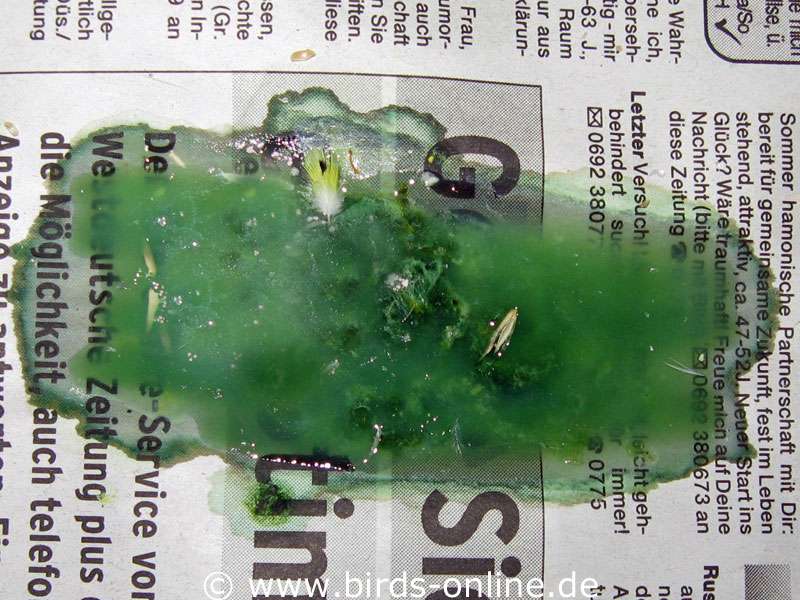
Several factors can cause green fecal components in the droppings. Budgies who weren’t eating enough for some time excrete green, sticky droppings with almost normally colored urine portions. Particularly in young birds who have just fledged, the excrements can sometimes be green without any underlying disease. Just fledged birds often eat too little, because they are not yet sufficiently trained in independent food intake. But also in young birds, other causes can lead to green discolored excrements.
You should in each case clarify why your bird does not eat anything or too little, otherwise, it may die of starvation. The animal may be suffering from an infection of the crop, which is often accompanied by vomiting. If you suspect your bird might suffer from an infection, she or he must be examined urgently by an avian vet and probably treated with medicine.
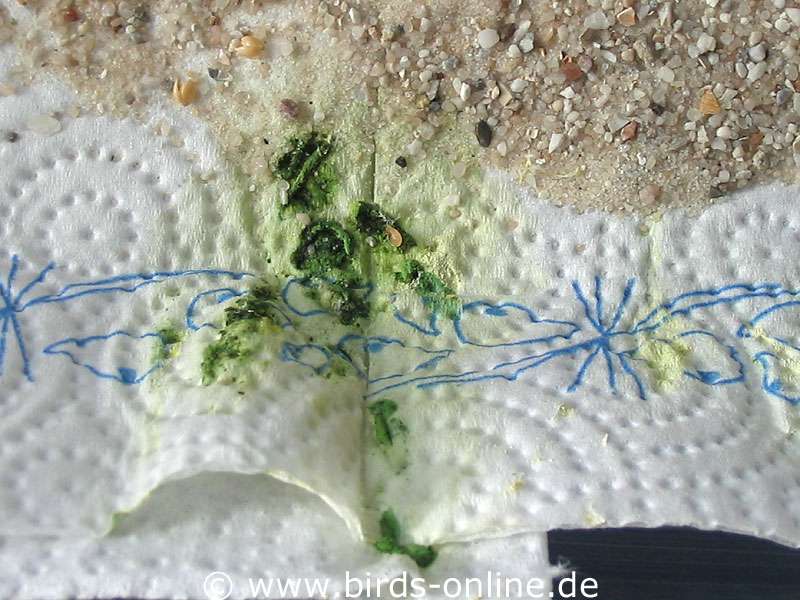
Green fecal components with yellow urine or droppings that are all over yellowish can indicate an internal organ disorder. For example, if the liver is damaged, the organism excretes increased amounts of bile, which leads to discoloration of fecal components and urine. When droppings like these appear, you should contact your avian vet as soon as possible. Liver disorders must be treated quickly since the organ can heal under certain circumstances. Regarding budgies, fatty degeneration of the liver is one of the most frequent causes of dysfunctions of this organ.
Important note: A yellowish-greenish discoloration of the droppings can be caused by the intake of vitamin B supplements. If a bird has to take a high dose of the vitamin B complex, the urine portion of the droppings usually turns yellowish.
Undigested food in droppings
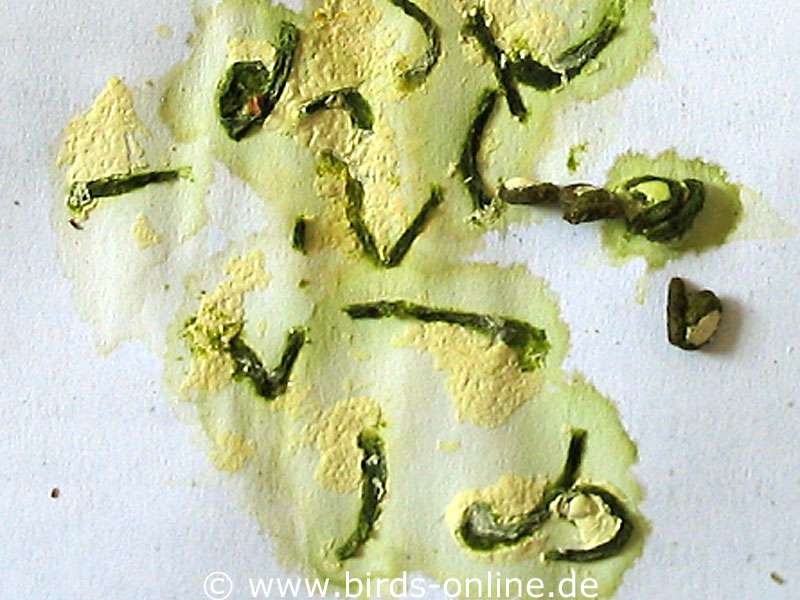
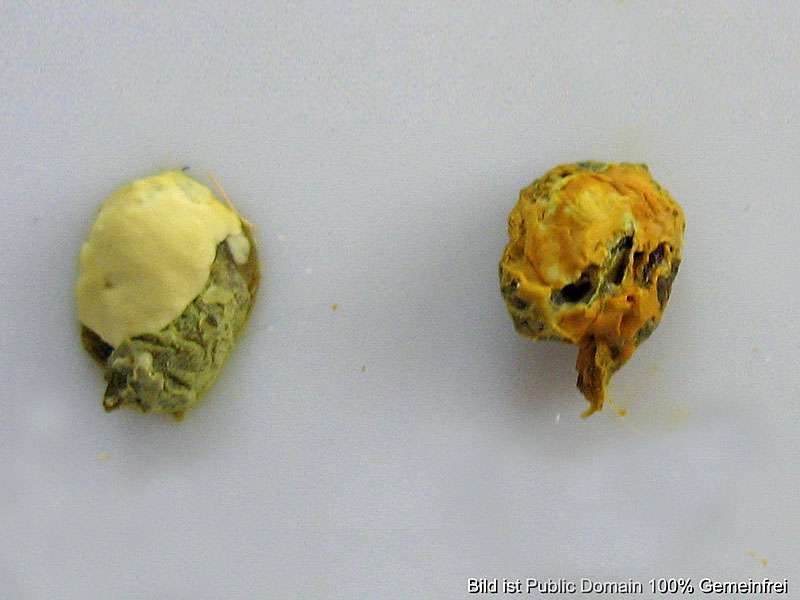
If you find undigested food like seeds or pieces of vegetables in your bird’s droppings, the digestion is severely impaired. The animal could starve or become nutritionally deficient if you do not take your bird to an avian vet quickly. There are numerous possible causes for such serious digestive disorders. Quite often, you have to deal with avian gastric yeast (Megabacteria). This pathogen occurs in a large number of budgies. In other bird species, bacterial infections can cause undigested grains to be found in the droppings. This can sometimes be observed in Lineolated parakeets, for example.
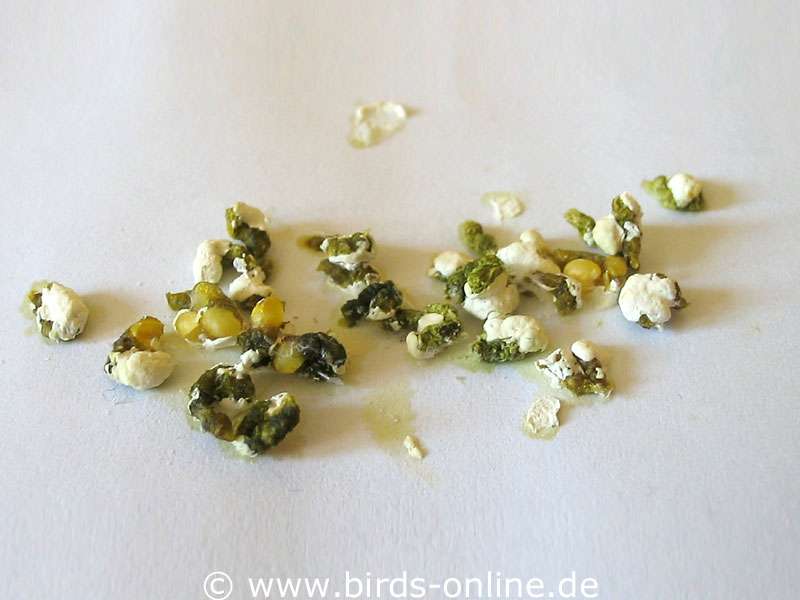
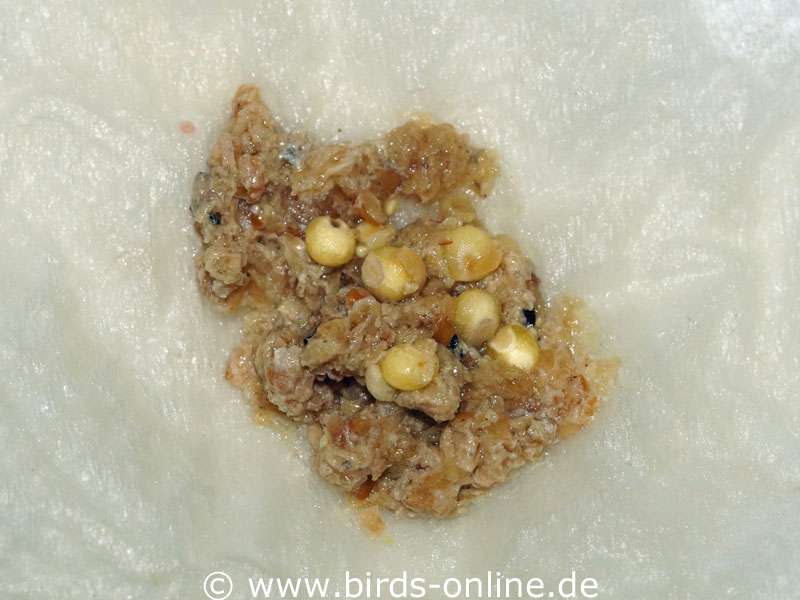
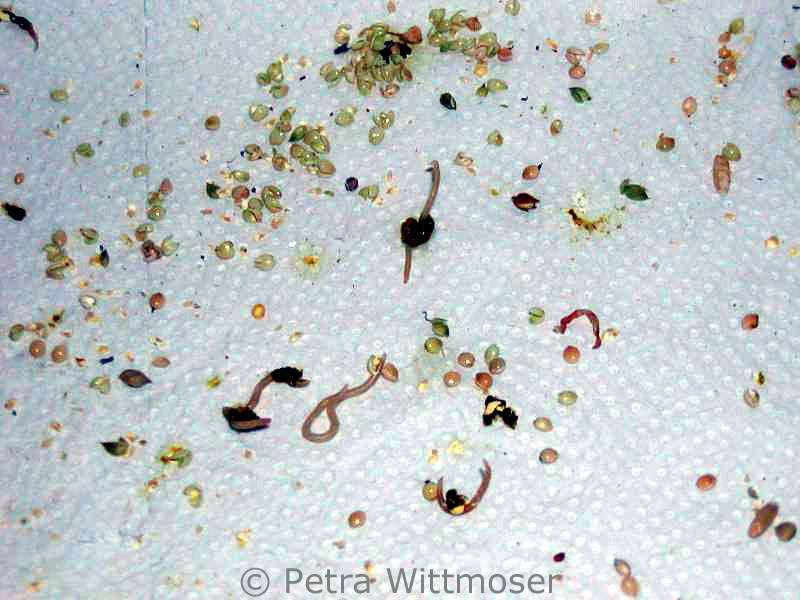
Occasionally it also happens that pet birds excrete parasites like roundworms with their droppings. Usually, this will occur during or after a deworming treatment. If you suddenly find a roundworm in your bird’s feces on the floor without having done a deworming first, the bird must be taken to a vet urgently to initiate treatment. It is important to start therapy as soon as possible. Because of their body length, roundworms can become knotted in a bird’s intestine and thus lead to a fatal intestinal obstruction. An infestatwiion with these parasites is therefore always in need of treatment.
Distribution of the droppings on the floor
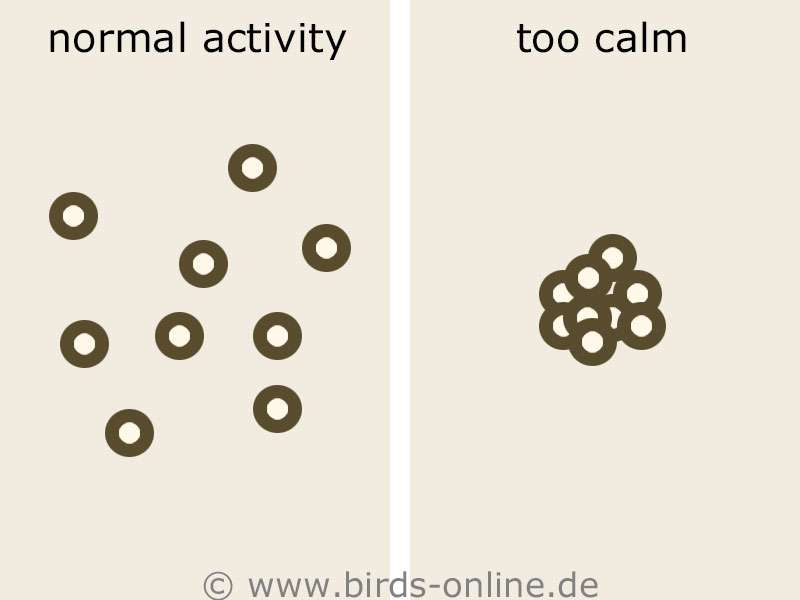
The distribution of the droppings on the floor of the cage or aviary can provide clues as to whether and when a bird is calm and sleeping. The time of day should be taken into account, as different distribution patterns are common at night during the natural resting period than in the day.
At nighttime, a healthy bird should be perched in one place and sleep soundly. So the animal hardly moves while it’s asleep. The droppings, therefore, pile up in a narrow space, as you can see in the left part of the adjacent illustration. On the other hand, if the bird is restless and sleeps poorly, she or he will move at night and spread the droppings more widely, as the right part of the schematic illustration shows. In case the droppings are distributed in this way, for example, parasites such as blood-feeding mites could deprive your bird of sleep.
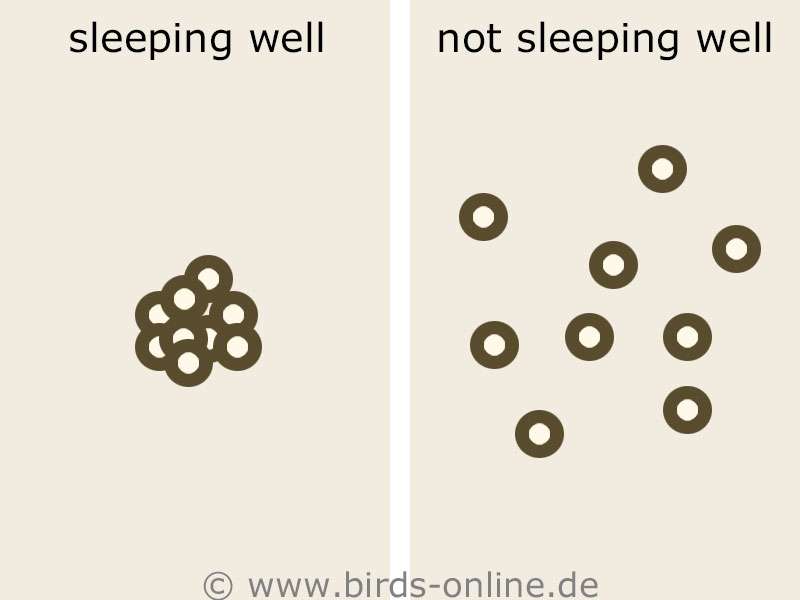
During the day it is exactly the opposite. A healthy and active bird distributes her or his droppings widely because she or he moves frequently. Piled droppings during the day, as sketched in the right part of the adjacent schematic illustration, may indicate excessive resting periods and thus a possible disease.