
- >>
- Birds Online – English
- >>
- Health and diseases
- >>
- General health topics
- >>
- Hospital cage
Hospital cage
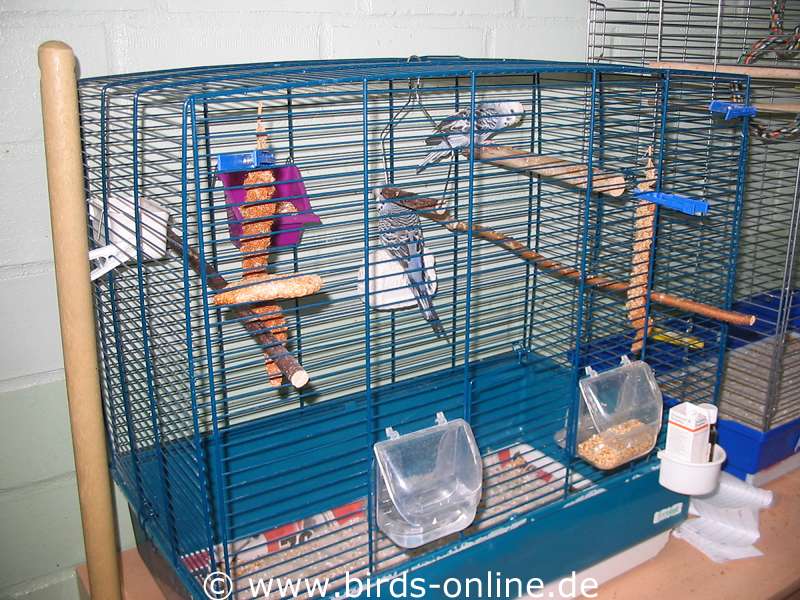
Most feathered patients need rest and must be caught at least once a day due to potential medication. For its conspecifics and particularly for the sick bird, it would mean enormous stress if the other birds would always be frantically flying while the owner tries to catch the sick bird. Therefore, you should have a hospital cage ready for such cases to be able to temporarily separate the bird from the flock or partner.
The hospital cage should be equipped with all the conveniences that your bird is familiar with from everyday life. Fortunately, many sick birds won’t sleep most of the day. So there is no reason to deny them the usual amenities during their stay in the hospital cage. Unless, of course, the current state of health prohibits certain things because they would overexert the animal or otherwise put your bird at risk.
Sometimes it is necessary to accommodate two or more birds in a hospital cage. For the birds, this is usually particularly pleasant because they are not alone. But even then it can be helpful if they find for example some toys in the hospital cage.
Size of the hospital cage
The hospital cage should be large enough for a bird to feel comfortable in it even over a longer time. Some diseases require weeks of accommodation in a hospital cage, so it should not be too small. On the other hand, it should not be too big either. An important reason for this is that many bird owners use the hospital cage to transport the bird to the avian vet. You might somehow be able to get a large parrot cage into a car. To fix the cage securely so that it won’t fall over during the first braking maneuver is often hardly practicable. Besides, it means considerable stress for the bird to be caught in the veterinary practice from a large cage with numerous possibilities of escape or hiding. From a rather small cage, on the other hand, the animals are usually relatively easy to catch.
Regarding the size of the hospital cage, choose the happy medium. Or even better: At home, you can use a spacious hospital cage and place the bird in a small box for the transport to the vet.
Bowls, perches, and more
Feeding cups and a dish for treats should be available in the hospital cage. Another dish for grit should be kept in reserve in case the disease prohibits covering the cage floor with bird sand and grit. Since the grit is important for the budgie’s digestion, it should be served in a dish then. Of course, the hospital cage should also be equipped with a water bowl or a hanging water dispenser.
Birds who suffer from a concussion, for example, can drown in larger bowls due to their balance problems. For their safety, it is advisable to attach a water dispenser to the grille.
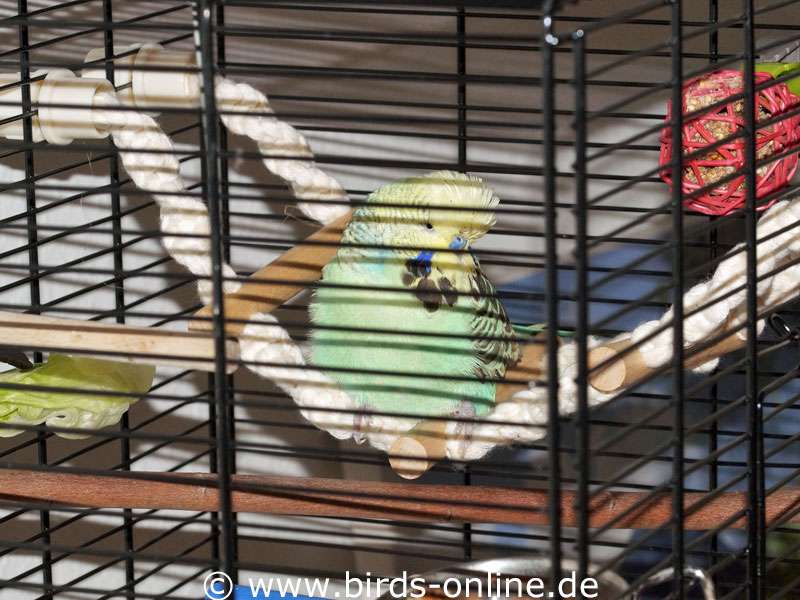
Equally important are appropriate perches, which are ideally natural branches. Although they are ill, many feathered patients like to perch on a swing. But birds who suffer from coordination disorders or whose feet and legs are affected by an illness, should under no circumstances have a swing available in the hospital cage. For them, wide seat boards are more suitable, for example, made of wood or cork. To supply the mineral balance of feathered patients sufficiently, a mineral stone should not be missing either.
Covering the floor of the hospital cage
Depending on the disease, it may not make sense to cover the cage floor with loose sand. For example, if the bird has an injury on its feet the sand would contaminate this wound as soon as the animal moves to the floor. In such cases, you should avoid any kind of loose floor covering. Instead, put a newspaper or kitchen paper towels on the floor of the cage. This material binds the moisture of your bird’s droppings. Keep in mind that you should never cover the cage floor with kitchen paper towels while your bird is still bleeding. Your little patient may stand on the absorbent material and it will stick to the wound. If the kitchen paper towel is later detached from the blood crust, the wound could start bleeding again.
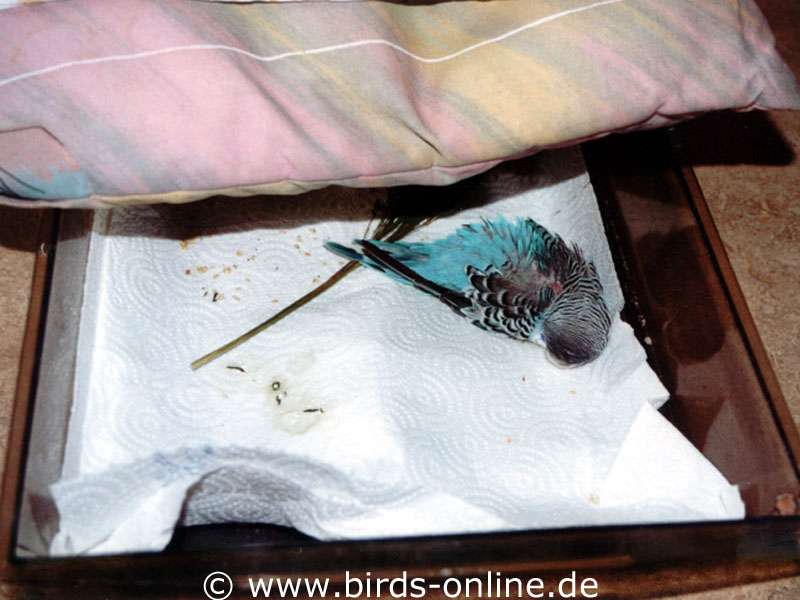
Do you suspect an infestation with internal parasites such as roundworms? Then you should not place or spread anything on the cage floor. Feces samples, which the avian vet needs for the detection of parasites, must neither stick to paper nor be polluted by sand. The same applies to feces samples to be tested for bacteria or fungi that may have spread in your bird’s digestive system.
If a sick bird suffers from a broken bone, you should pad the cage floor. Loosely crumpled newspaper or, even better, crumpled kitchen paper towels are suitable for this purpose. Please do not use wool or other fibrous materials, as the single threads could wrap themselves around the bird’s limbs and cause severe constrictions.
