Beak
The beak, bill, or rostrum is a body part that is typical in birds. It consists of keratin which covers a bony core like a shell. This core is the jawbone. At least in some small parts, tiny blood vessels run through the keratin part of the beak. Some parts of the beak, however, are not supplied with blood.
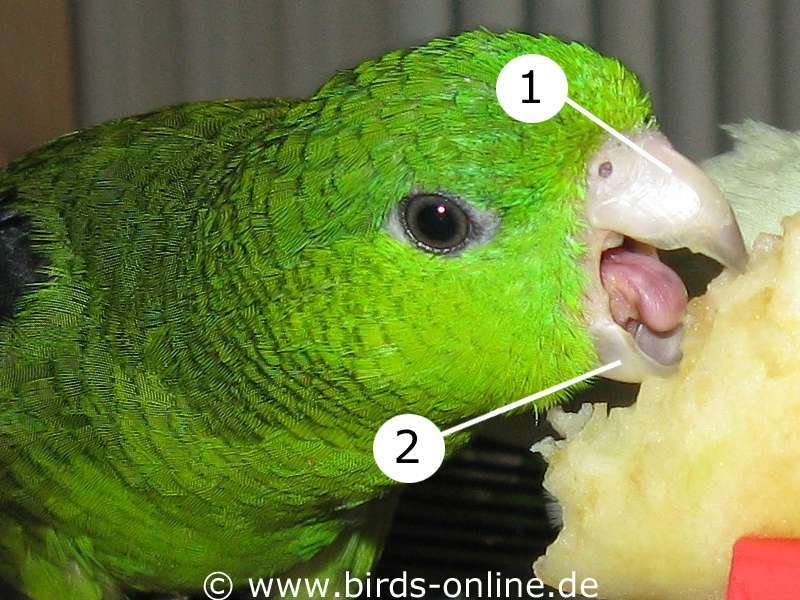
All members of the parrot family (Psittaciformes) have a curved beak. It consists of two parts with different shapes and length: the upper and lower beak. They’re also called maxillary beak (upper part) and mandibular beak (lower part), and also sometimes they’re called upper and lower mandible. Usually, only the longer, pointed and more curved upper beak is visible, see (1) in the picture on this page.
Birds can move the upper beak with the help of muscles. Moving it vertically means the birds open or close their beak. In most cases, the smaller, semi-circular lower beak (2) is only visible while the bird opens the beak, i. e. moves the upper beak upwards. Unlike the upper beak, the lower beak is not pointed but gently curved. Its edge touches the upper beak at its inner surface while the beak is closed.
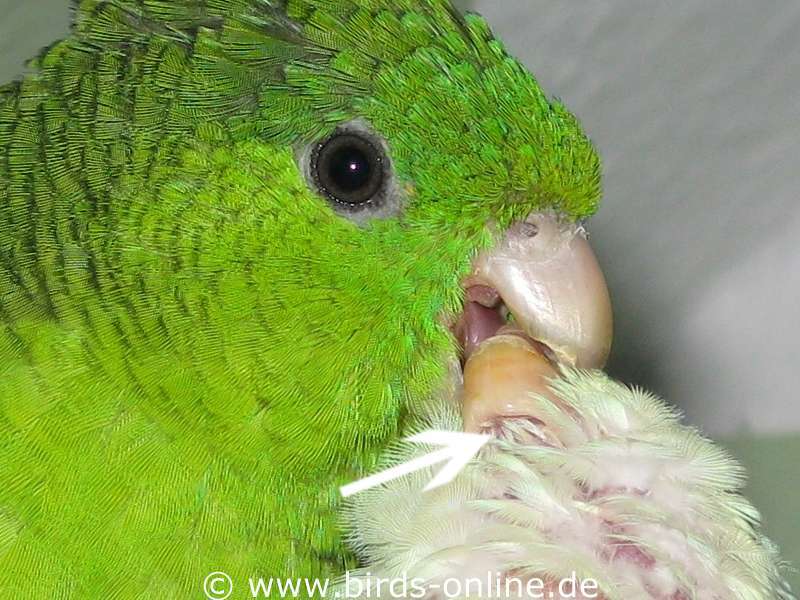
If you look at a parrot’s lower beak from below, you can see that the skin at the throat is naked and that there is a gap between the beak and the throat. This gap is no sign of an illness, it’s an adaption to how the birds use the beak and where it’s located. Birds need this gap so that they can swallow bigger food particles without squeezing the esophagus. Because when the food slips down the esophagus, it bulges a bit – and therefore the tiny gap between the lower beak and the throat is so important.
While the birds are preening or after they have been taking a bath, it’s quite easy to see the naked throat and the tiny gap mentioned above. The illustration next to this paragraph shows a cream-colored female Lineolated Parakeet. She waits to be fed by her partner and therefore is in a special posture. Thus the gap tiny is visible from below, see arrow marking.
