The main part of a budgie's daily diet
is a bird seed mixture which contains different
grains and seeds.
These seeds need to be peeled before the budgies can eat them. The beak is a perfect tool
for peeling the seeds and therefore guarantees the survival. It is necessary that the beak
is intact; else the bird is not able to eat enough. In case the beak gets hurt in an
accident or fight with another bird, the budgie is in trouble because this could mean he
is no longer able to eat and he would soon die from starvation. Such birds need help to
survive until the beak is healed and they can peel their seeds again.
Consequences of an injury
If a flying bird for example crashes into a mirror or a window, this may cause
a beak injury like a bruise. Due to such a collision often the beak even breaks off
- in most cases the
upper mandible is affected since it directly hits the obstacle. The lower mandible is
protected by the upper one and therefore in general it won't get injured in a crash. But with
only one intact half of the beak, a budgie is not able to eat.
When a budgie peels the seeds the lower mandible which is rigidly coupled to the skull is
used for fixing the grains. The upper mandible can be moved by the bird and the edge of the
lower one separates the glumes from the grains. When the upper mandible is broken or seriously
injured the affected bird is no longer able to use the beak for peeling the seeds. Since
budgies do not swallow seeds that still are covered by their glumes the loss of a part of the
upper mandible often causes starvation. Even pellets can't be swallowed when the upper beak is
seriously injured because toughing the wound hurts - and while a bird is eating the pellets
would of course touch the wound edge.
But losing a part of the upper mandible doesn't always mean starvation for a budgie.
Sometimes the remaining part of the upper mandible is long enough to enable the bird to
fix the seeds between the upper and the lower mandible and peel the glumes off after the
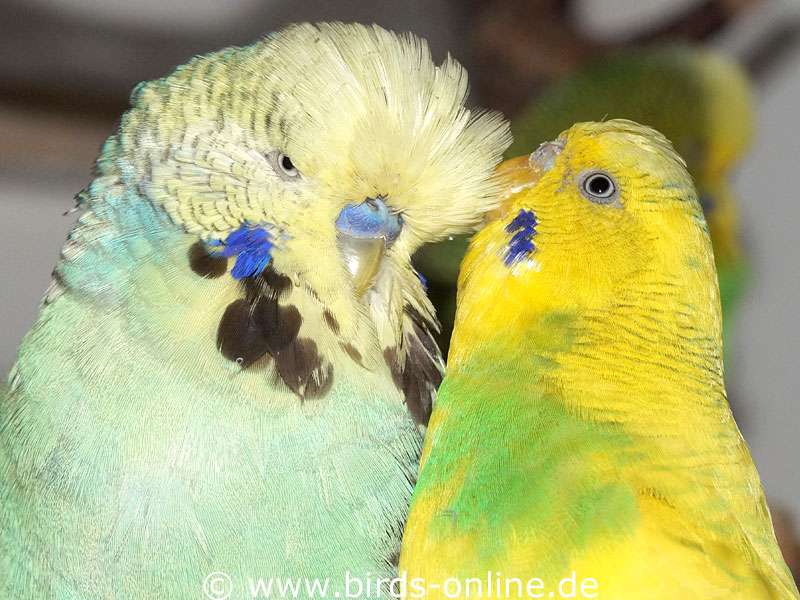
initial wound has healed. The blue budgie who is shown in the photos above is an example for
a lucky bird who was still able to eat seeds after the upper mandible broke.
Here you can visit Kiki's website.
Regrettably it is not very likely that a budgie whose upper mandible has broken off close to
the cere will ever be able to peel seeds again. Such injuries do heal but often the
beak won't regrow to its natural size. Even though it is a hard decision one has to take
sometimes it is better to put the poor patient down. The only way to save such a bird from
starvation is feeding it by hand several times each day for the whole rest of the life.
This is not easy because the
special food is soft and many birds don't like to swallow mashed grains and seeds. If you
have to feed a bird who is not tame it is a torture for you and the budgie. Therefore you
should discuss the particular case with an avian vet and find out what is best for the bird:
a torture every time you feed him or being put to sleep.
But don't worry, I have also heard about budgies who have learned to take their special
soft food from a spoon. They soon started to trust their owners and it became quite easy to feed
them.
The first days after the accident
Right after the collision the edge of the broken beak is very algesic and starts to bleed
again when it's touched. To be honest it is not easy to make a bird whose beak hurts eat
anything. Therefore it is recommended to ask an avian vet for an analgesic that's suitable for
birds. Soft food like egg food and crushed fresh food (apples, bananas, vegetables...) are
a good choice. You can also try baby food, but it may not contain lactose because budgies
can't digest it.
Another way to help is peeling the seeds before handing them to your injured bird. Put the
seeds between two pieces of cloth and then use a rolling pin to crack the glumes. The seeds
should not break, only the glumes should be removed from the grains. From time to time take
away the upper piece of cloth and softly blow the glomes away. Repeat these steps until the
seeds are ready to be handed to your injured bird. Tip: Most health food stores offer
peeled or cracked millet that can be used as a special diet food for a bird whose beak is
hurt. And by the way, most injured birds prefer to eat presoaked millet/grains. Please do
not feed your budgie on millet only for more than one week. Birds need a variety of different grains
and seeds to stay healthy. An unbalanced diet with only one component
(=millet) will soon lead to deficiency symptoms! And of course you should discuss this
special diet with your avian vet.
As soon as you notice that the edge of the broken beak doesn't seem to hurt anymore you can
offer your bird presoaked seeds (seed mixtures). You should carefully watch your bird to
make sure your budgie won't suffer anorexia. Many budgies learn to eat with a broken
beak. Even though often it won't regrow to the full natural length the birds will be
able to lead a good life with their handicap. You should check your bird's weight at least
once a week. Budgies should not be lighter than 35 to 45 grams. If you are not sure about
your bird's nutritional condition you should talk to your avian vet who will sure help you
to learn how to find out whether a budgie is underweight or not.
A remarkable case
The lovebird who is shown on the right and below is a very remakable case. Its owner brought the bird to a vet because he wanted to let him cut the upper beak which was too long. The reason for this was that the lower beak was missing. Due to a trauma the bird lost its lower beak half a year ago. In general, birds die after such a severe injury because they're unable to eat their grains and seeds. But this lovebird somehow managed to survive. Most probably he had been eating soft food such as fruit and vegetable since he host his lower beak due to the collision. There is no other possible explanation for his survival, the owner stated the bird eats on his own.
This chapter in Turkish on muhabbetkusu.org
|